


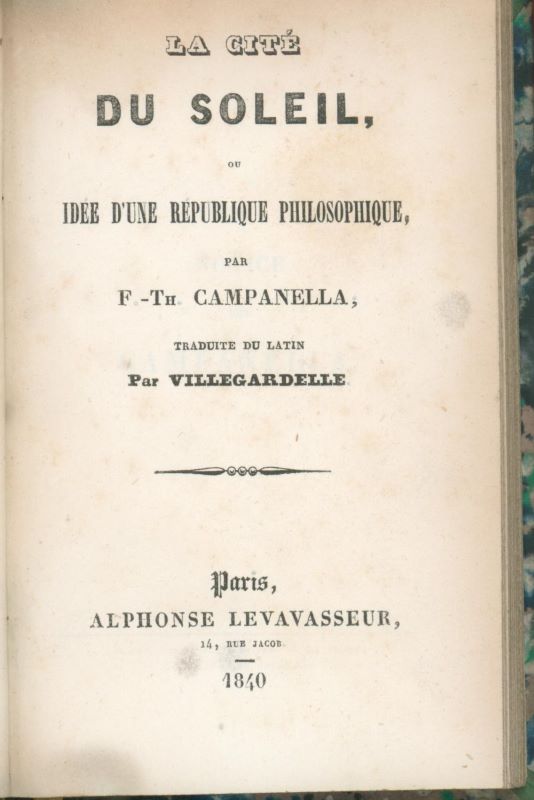
CAMPANELLA, F. Th. La Cite du Soleil ou Idee d’une Republique Philosophique.
(Paris): Alphonse Levavasseur, 1840. First edition. Hardcover. 13.3 by 8.5cm. 171 pages. This is the first French translation of Campanella’s Civitas Solis, translated from the Latin by François Villegardelle. Among the earliest vernacular editions of Campanella’s celebrated work, composed in 1602, whilst the author was imprisoned following the failure of his anti-Spanish conspiracy in Calabria, it was first published in 1623 in a Latin version; the original Italian text remained unpublished until the twentieth century.
Presented as a dialogue between a Genoese navigator and a Knight Hospitaller, it describes the City of the Sun, a rigorously ordered society governed by reason, education, communal ownership, and collective labour. Property, family life, and individual wealth are subordinated to the common good; knowledge is organized systematically; work is distributed amongst all citizens; and political authority is exercised through a hierarchy combining philosophical wisdom, religious symbolism, and scientific understanding. The city itself, arranged in concentric circles corresponding to the planetary order, embodies Campanella’s attempt to reconcile metaphysics, astronomy, theology, and politics within a single vision of social harmony.
Although frequently grouped with the utopian literature of the Renaissance, Campanella’s work extends well beyond the humanist tradition represented by More. Its advocacy of communal property, planned production, collective education, and the subordination of private interests to social utility led nineteenth-century readers to regard it as a precursor of modern socialist thought. Published at a time of intense French interest in Fourierism, Saint-Simonianism, and other reformist movements, Villegardelle’s translation introduced Campanella to a new audience already engaged with questions of social reorganization, equality, labour, and the possibility of constructing an ideal society.
A very good copy in contemporary quarter leather over marbled boards, marbled endpapers, and silk ribbon marker; some light foxing, contemporary paper label (with the numbber 44) to spine base, otherwise a particularly pleasing example. A landmark in the history of political philosophy, utopian literature, and early socialist thought, and one of the most influential imaginative constructions of the ideal state produced in early modern Europe.
$1,500.00
1 in stock